Approaches for Implementing Governance Strategies
Governance strategies
Approaches to governance strategies
When working with generative AI solutions, it's important to establish and follow governance strategies to ensure responsible development and deployment. The following are some key approaches to consider.
Policies
Develop clear and comprehensive policies that outline the organization's approach to generative AI, including principles, guidelines, and responsible AI considerations. Here are some common characteristics of policies:
- Policies should address areas such as data management, model training, output validation, safety, and human oversight.
- Policies should also cover aspects like intellectual property, bias mitigation, and privacy protection.
- Ensure these policies are regularly reviewed and updated to keep pace with evolving technology and regulatory requirements.
Review cadence
Implement a regular review process to assess the performance, safety, and responsible AI implications of the generative AI solutions. Here are some common tasks to include in the review process:
- The review process could involve a combination of technical, legal, and responsible AI reviews at different stages of the development and deployment lifecycle.
- Establish a clear timeline for these reviews, such as monthly, quarterly, or bi-annually, depending on the complexity and risk profile of the solutions.
- Ensure that the review process includes diverse perspectives from stakeholders, including subject matter experts, legal and compliance teams, and end-users.
Review strategies
Develop comprehensive review strategies that cover both technical and non-technical aspects of the generative AI solutions. Here is some suggested guidance for a review strategy:
- Technical reviews should focus on model performance, data quality, and the robustness of the underlying algorithms.
- Non-technical reviews should assess the solutions' alignment with organizational policies, responsible AI principles, and regulatory requirements.
- Incorporate testing and validation procedures to validate the outputs of the generative AI solutions before deployment.
- Establish clear decision-making frameworks to determine when and how to intervene or modify the solutions based on the review findings.
Transparency standards
Commit to maintaining high standards of transparency in the development and deployment of generative AI solutions by ensuring the following:
- Include publishing information about the AI models, their training data, and the key decisions made during the development process.
- Provide clear and accessible documentation on the capabilities, limitations, and intended use cases of the generative AI solutions.
- Establish channels for stakeholders, including end-users, to provide feedback and raise concerns about the solutions.
Team training requirements
Ensure that all team members involved in the development and deployment of generative AI solutions are adequately trained on relevant policies, guidelines, and best practices. Some suggestions for team training include the following:
- Provide comprehensive training on bias mitigation, and responsible AI practices.
- Encourage cross-functional collaboration and knowledge-sharing to foster a culture of responsible AI development.
- Consider implementing ongoing training and certification programs to keep team members up to date with the latest advancements and regulatory changes.
Monitoring an AI system
Monitoring
Monitoring an AI system is necessary to ensure its performance, reliability, and compliance with the intended use case. Effective monitoring can help identify issues, optimize system performance, and maintain overall system health.
The following are some key aspects to consider when monitoring an AI system.
Performance metrics
Monitor the performance of the AI system by tracking metrics, such as the following:
- Model accuracy: The proportion of correct predictions made by the model
- Precision: The ratio of true positive predictions to the total number of positive predictions made by the model
- Recall: The ratio of true positive predictions to the total number of actual positive instances in the data
- F1-score: The harmonic mean of precision and recall, which provides a balanced measure of model performance
- Latency: The time taken by the model to make a prediction, which is an important measure of a model's practical performance
These metrics can help you assess the effectiveness of the AI model and identify areas for improvement.
Infrastructure monitoring
Monitor the underlying infrastructure that supports the AI system, including the following:
- Compute resources (for example, CPU, memory, GPU)
- Network performance
- Storage
- System logs
This can help you identify resource bottlenecks, capacity planning issues, and potential system failures.
Monitoring for bias and fairness
Regularly assess the AI system for potential biases and unfair outcomes, especially in sensitive domains such as healthcare, finance, and HR. This can help ensure the AI system is making fair and unbiased decisions.
Monitoring for compliance and responsible AI
Ensure the AI system's operations and outputs adhere to relevant regulations, industry standards, and responsible guidelines. Monitor for any potential violations or issues that could raise compliance or responsible AI concerns.
Generative AI Security Scoping Matrix
You can use the Generative AI Security Scoping Matrix to assist you with application security scoping efforts. This matrix summarizes the key security disciplines that you should consider based on your generative AI solution. Use the matrix to guide you in classifying your applications among the five defined generative AI scopes.
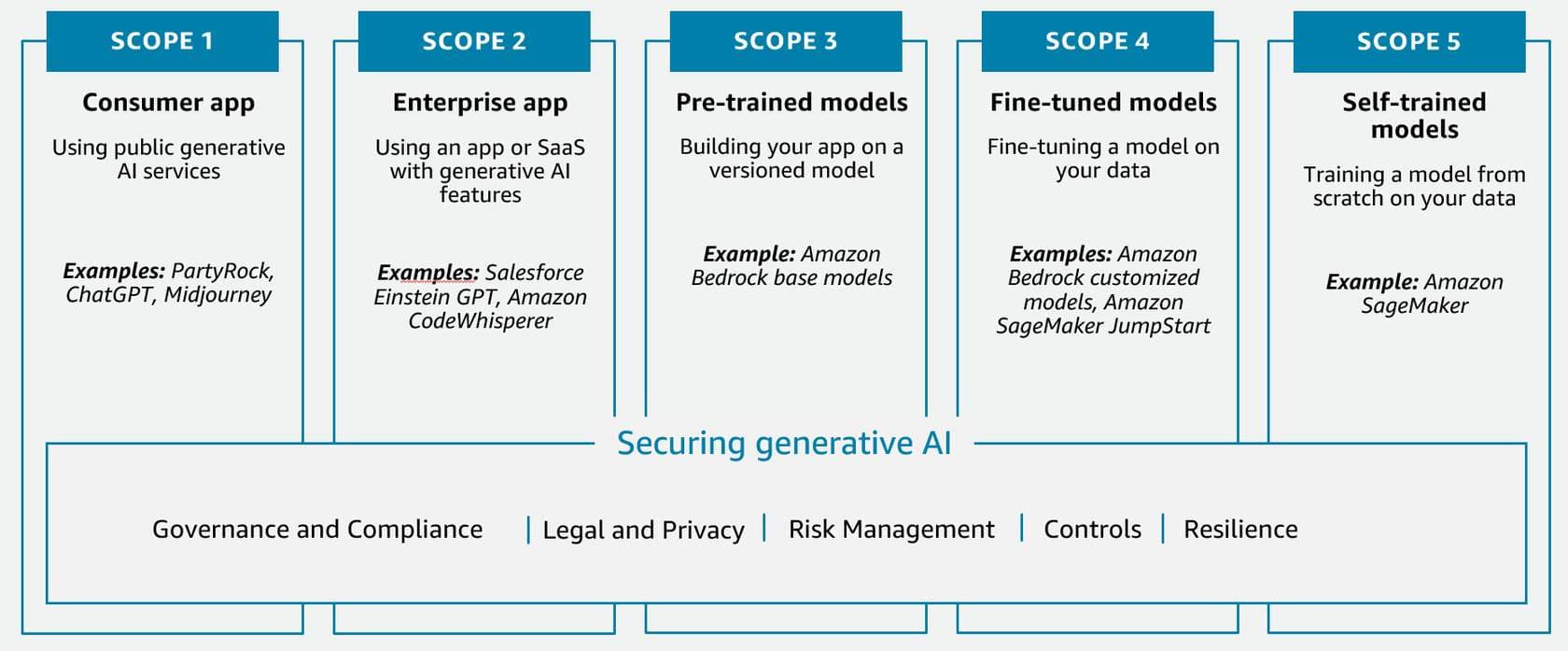
2: Scope 2: Enterprise app
2: Scope 2: Enterprise app
Your business uses a third-party enterprise application that has generative AI features embedded within, and a business relationship is established between your organization and the vendor.
Example: You use a third-party enterprise scheduling application that has a generative AI capability embedded within to help draft meeting agendas.
Security disciplines
The matrix provides guidance on how to apply the following security disciplines to each scope.
- Governance and Compliance
- Legal and Privacy
- Risk Management
- Controls and Resilience
Controls: The implementation of security controls that are used to mitigate risk
The following are some examples:
- Control who can use specific foundation models.
- Control access to inference endpoints.
Resilience: How to architect generative AI solutions to maintain availability and meet business Service Level Agreements (SLAs)
The following is an example:
- Ensure each AWS service is available in your chosen AWS Region.
Additional resources
Securing Generative AI: An Introduction to the Generative AI Security Scoping Matrix
To learn more about the Generative AI Security Scoping Matrix and how to use it, choose the following link.
AWS Security Blog
Securing Generative AI: Applying Relevant Security Controls
This post discusses the considerations when implementing security controls to protect a generative AI application. To learn more, choose the following link.
AWS Security Blog
Next, you will answer some questions to check how much you have learned in this section.