Machine Learning
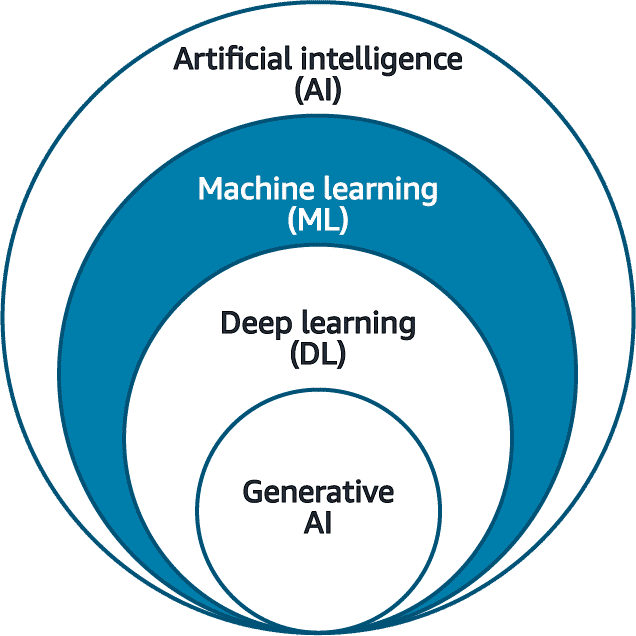
Remember, Machine Learning (ML) is a subset of AI that focuses on developing algorithms and statistical models so that computer systems can learn from data and make predictions or decisions without being explicitly programmed. ML models learn patterns and relationships from data rather than relying on hard-coded rules for instructions. These models are trained on large datasets, and their accuracy and performance improve over time as they process more data.
In this section, you will learn about when ML is an appropriate solution and the techniques used for specific use cases.
When AI and ML are appropriate solutions
To determine the appropriate AI solution, you must understand when to use AI to resolve a business problem. AI is a good choice for the following use cases:
- Coding the rules is a challenge: Many human tasks cannot be solved properly using simple, rule-based solutions. Take spam filtering for instance. Determining whether an incoming email is legitimate or spam is a complex task that cannot always be effectively tackled through a set of predefined rules. There are many variables at play. When rules rely on too many factors, have overlaps, or need to be finely tuned, it becomes difficult for humans to code them accurately. ML can be used to effectively solve this kind of problem.
- Scale of the project is a challenge: In the spam filtering example, a human might be able to look at a few hundred emails and determine if they are spam or not. However, scaling this task to scan through millions of emails would be tedious and inefficient. ML solutions are appropriate for large-scale problems like this.
Alternative approach to AI and ML
Notice in the previous section that AI can solve many problems. However, there might be situations where alternative approaches would be more suitable. Consider all approaches and select the most appropriate one based on the task’s specific requirements and constraints.
For example, you do not need ML if you can determine a target value using simple rules, computations, or predetermined steps. You can program the steps without needing any data-driven learning.
You have learned when AI and ML are appropriate and when an alternative solution is appropriate. Next, you will learn about ML techniques for selecting a model.