Fundamental Concepts of MLOps
MLOps
MLOps combines people, technology, and processes to deliver collaborative ML solutions.
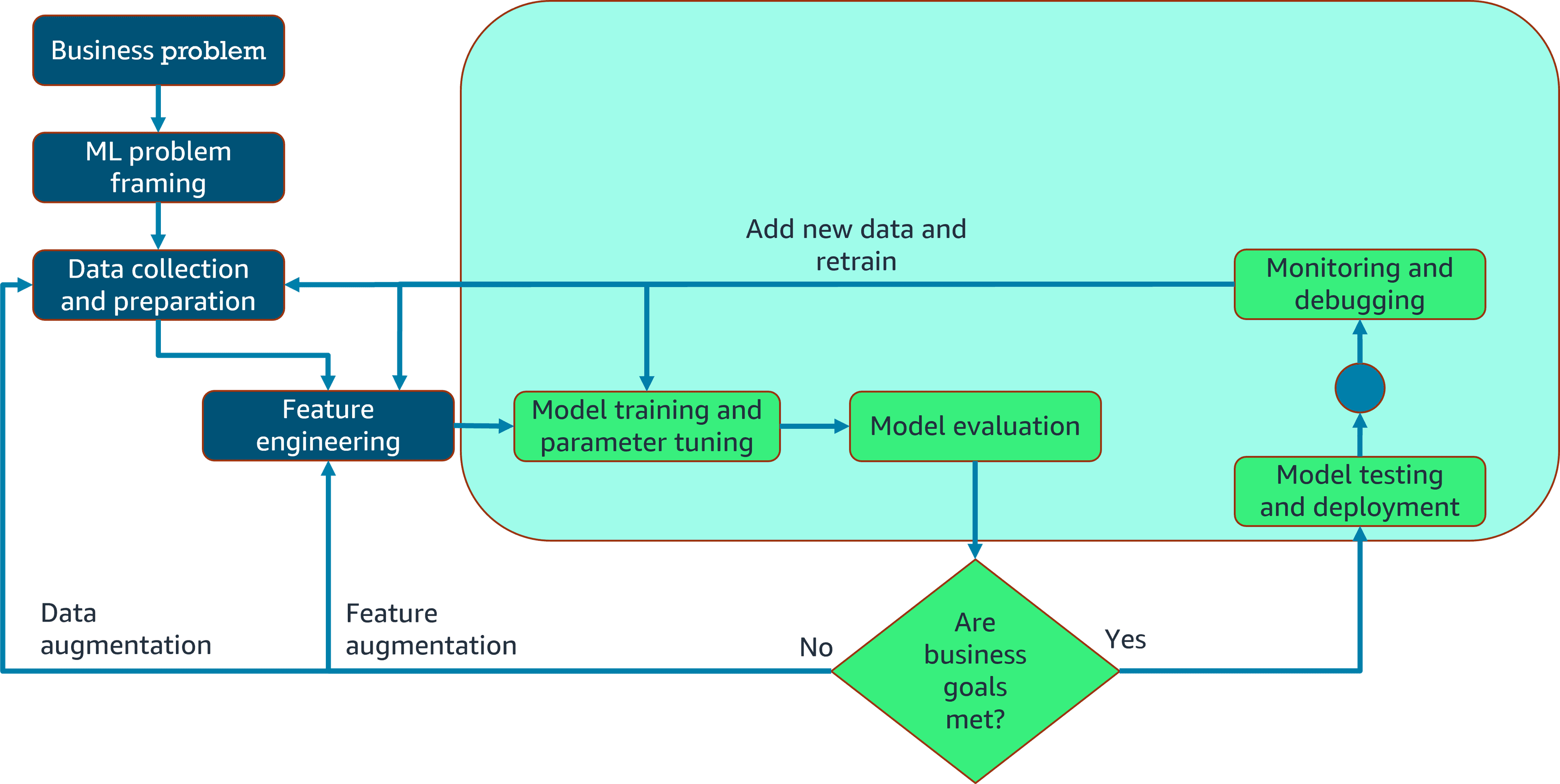
MLOps refers to the practice of operationalizing and streamlining the end-to-end machine learning lifecycle from model development and deployment to monitoring and maintenance. It helps ensure that models are not just developed but also deployed, monitored, and retrained systematically and repeatedly.
It is an extension of the DevOps principles and practices to the specific domain of machine learning systems.
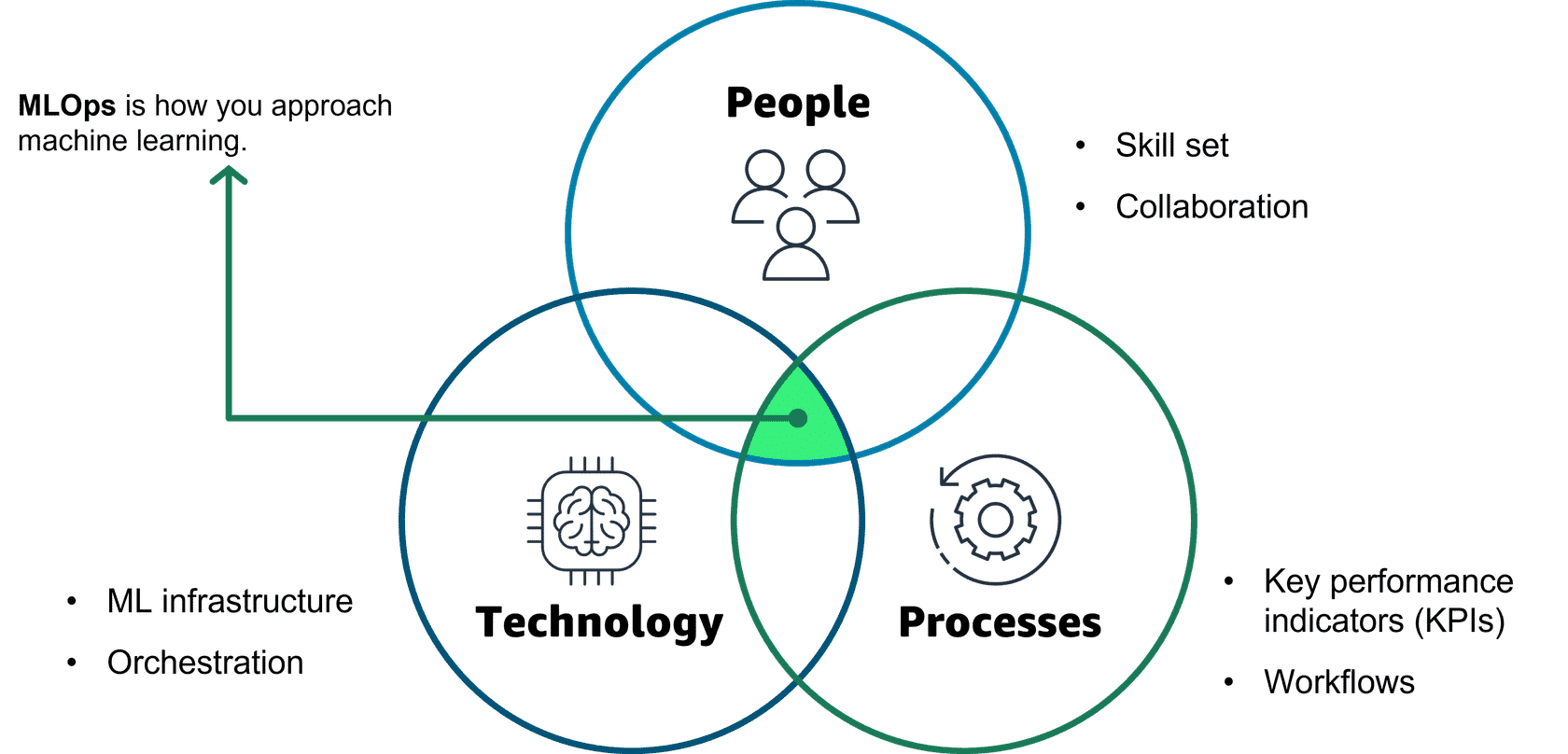
Like DevOps, MLOps relies on a collaborative and streamlined approach to the machine learning development lifecycle. It is the intersection of people, process, and technology that optimizes the end-to-end activities required to develop, build, and operate machine learning workloads.
Using MLOps
Applications that expose trained models might have different hosting requirements and strategies than standard applications. Trained models are sensitive to changes in data; therefore, a model-based application that works well when first implemented might not perform as well days, weeks, or months after being implemented. To account for these differences, you need different processes and procedures for applications that are based in managing ML.
MLOps accounts for the unique aspects of artificial intelligence and machine learning (AI/ML) projects in project management, continuous integration and delivery (CI/CD), and quality assurance. With it, you can improve delivery time, reduce defects, and make data science more productive.
Goals of MLOps
A goal of MLOps is to get ML workloads into production and keep them operating. To meet this goal, MLOps adopts many DevOps principles and practices for the development, training, deployment, monitoring, and retraining of machine learning models. The aim is to use MLOps to do the following:
- Increase the pace of the model development lifecycle through automation.
- Improve quality metrics through testing and monitoring.
- Promote a culture of collaboration between data scientists, data engineers, software engineers, and IT operations.
- Provide transparency, explainability, audibility, and security of the models by using model governance.
Benefits of MLOps
Adopting MLOps practices gives you faster time-to-market for ML projects by delivering the following benefits.
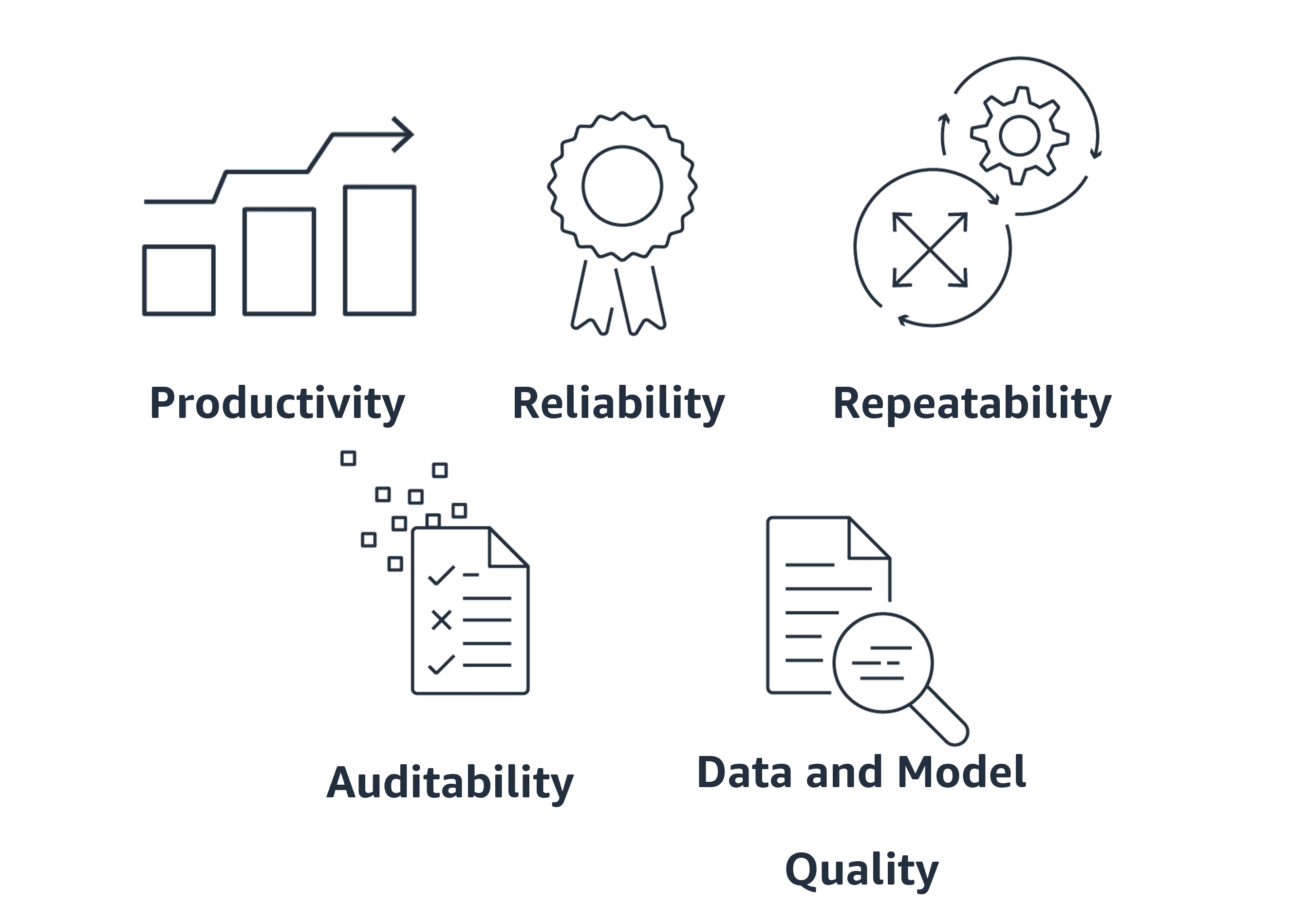
1: Productivity
By providing self-service environments with access to curated datasets, data engineers and data scientists can move faster and waste less time with missing or invalid data.
Key principles of MLOps
The key principles of MLOps include:
Version control
For reproducibility, machine learning workflows must track changes to assets like data, code, and models. It can be rolled back to previous versions when needed.
Overall, version control and code review provide reproducible, trustworthy machine learning.
Automation
For repeatability, consistency, and scalability, you can automate the various stages in the machine learning pipeline. This includes the data ingestion, pre-processing, model training, and validation and deployment stages.
Automated testing helps you discover problems early for fast error fixes and learnings.
CI/CD
Through automation, you can continuously test and deploy assets in the following ways:
- Continuous integration extends the validation and testing of code to data and models in the pipeline.
- Continuous delivery automatically deploys the newly trained model or model prediction service.
- Continuous training automatically retrains ML models for redeployment.
- Continuous monitoring uses data monitoring and model monitoring of metrics related to business.
Model governance
Good governance of machine learning systems requires close collaboration between data scientists, engineers, and business stakeholders. Clear documentation, effective communication channels, and feedback mechanisms help align everyone and improve models over time. It is also crucial to protect sensitive data, secure access, and meet compliance rules. A structured process for reviewing, validating, and approving models before deployment checks for fairness, bias, and ethics. Governance manages all aspects of systems for efficiency.
ML lifecycle and MLOps
Most ML workloads involve the management of code, data, and models.
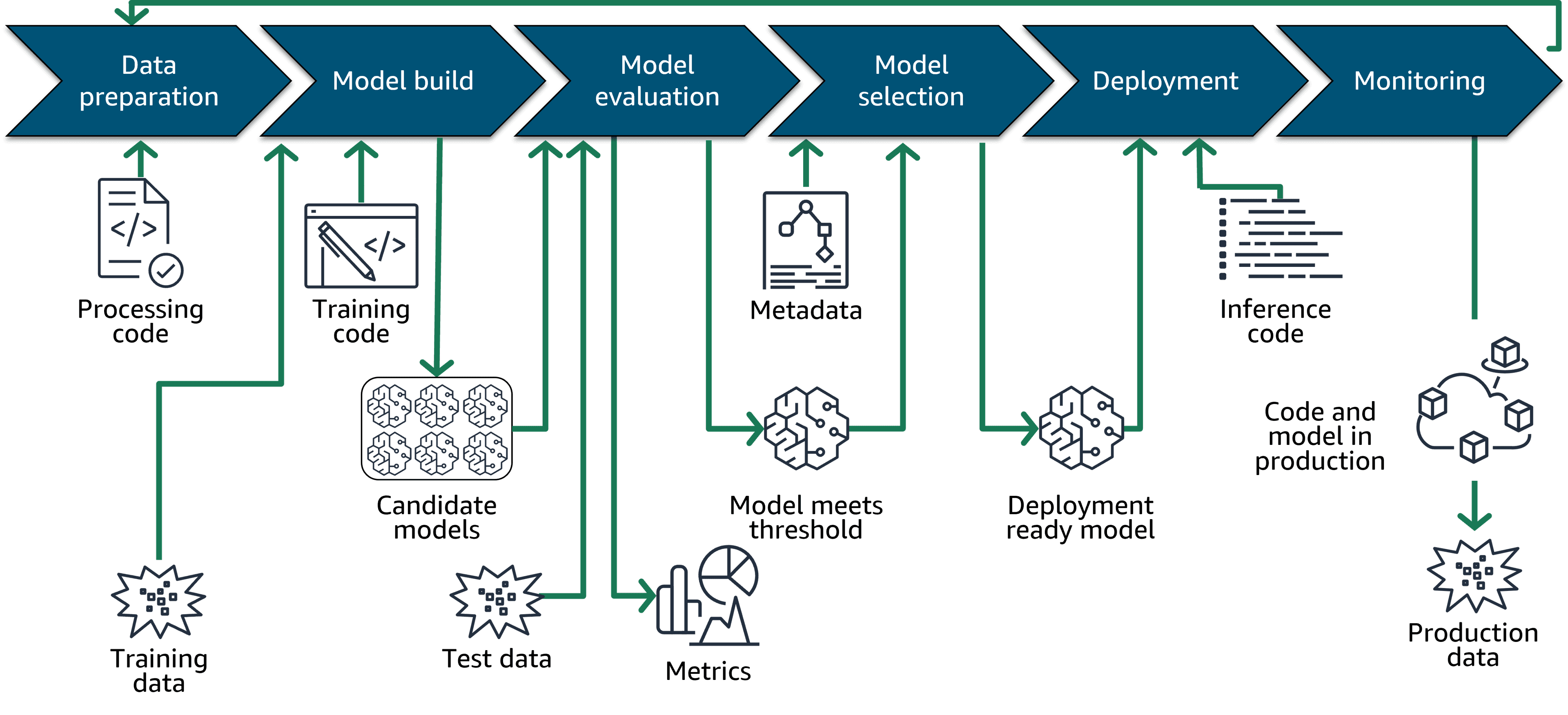
Managing code, data, and models throughout the ML lifecycle requires the following touchpoints:
- Processing code in data preparation
- Training data and training code in model building
- Candidate models, test, and validation data in model evaluation
- Metadata during model selection
- Deployment-ready models and inference code during deployment
- Production code, models, and data for monitoring
With MLOps, you operationalize the processes around ML model development, deployment, monitoring, and governance.
Implementing MLOps
The following diagram is an example of an end-to-end automation process. A productionized ML lifecycle typically contains separate training and deployment pipelines.
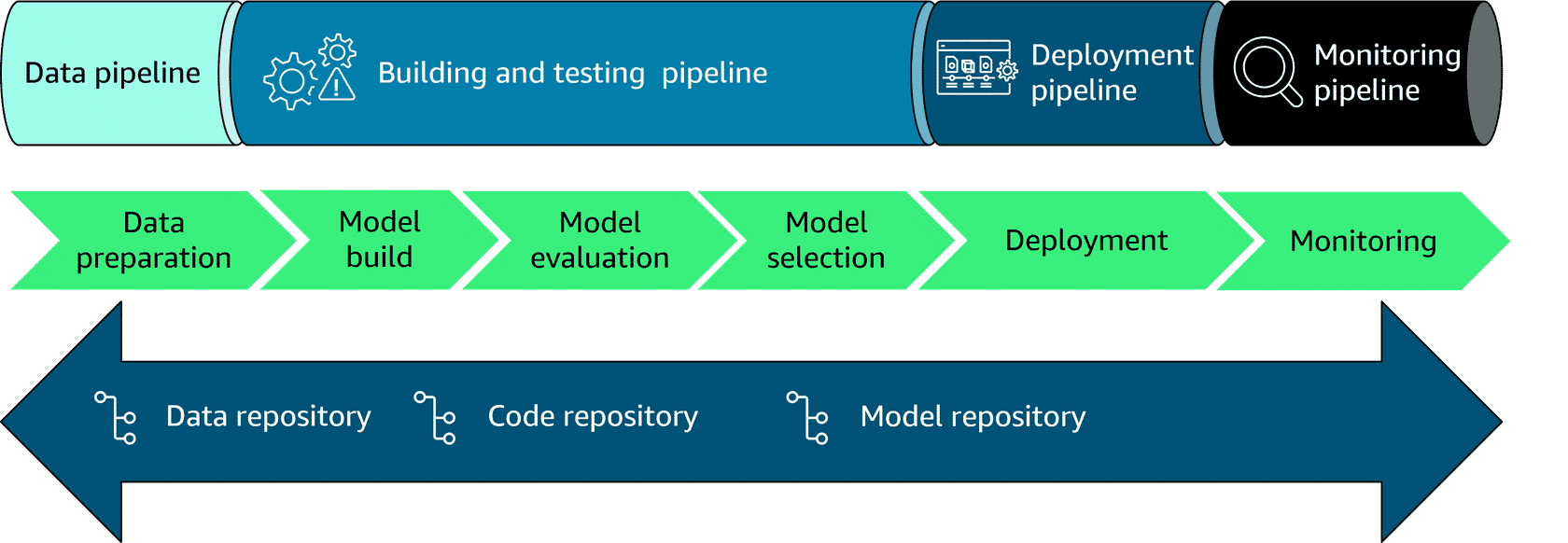
1: Model build
The model building pipeline creates new models upon initiation, for example when new data become available.
MLOps levels of implementation can vary depending on organizations and projects.
AWS services for MLOps
In the following diagram, you can see which AWS services can be used to implement an MLOps pipeline.
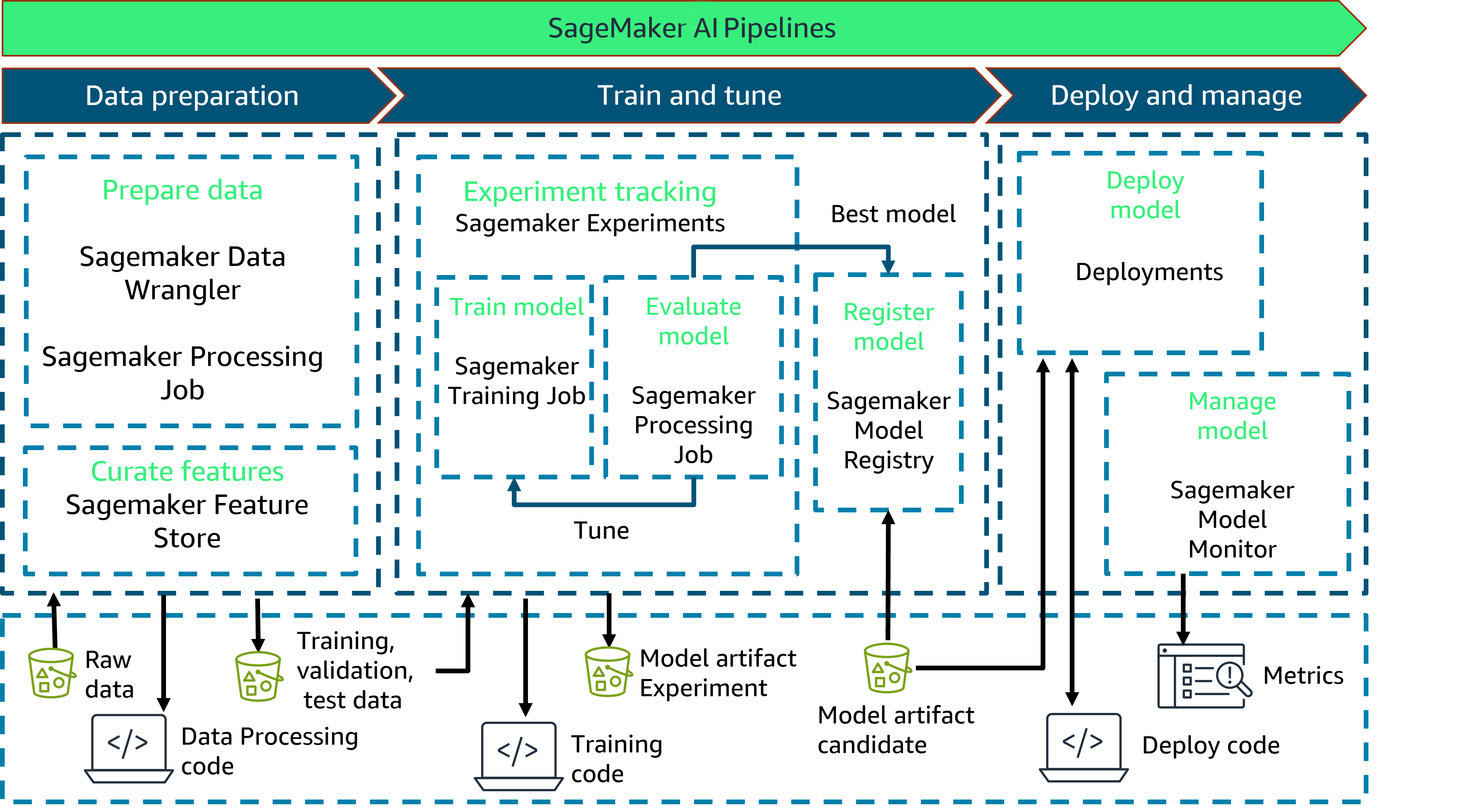
1: Prepare data
SageMaker Data Wrangler is a LCNC tool that provides an end-to-end solution to import, prepare, transform, featurize, and analyze data by using a web interface.
By using the SageMaker AI Processing API, data scientists can run scripts and notebooks to process, transform, and analyze datasets various ML frameworks such as scikit-learn, MXNet, or PyTorch while benefiting from fully managed machine learning environments.