Conclusion
Machine learning development lifecycle
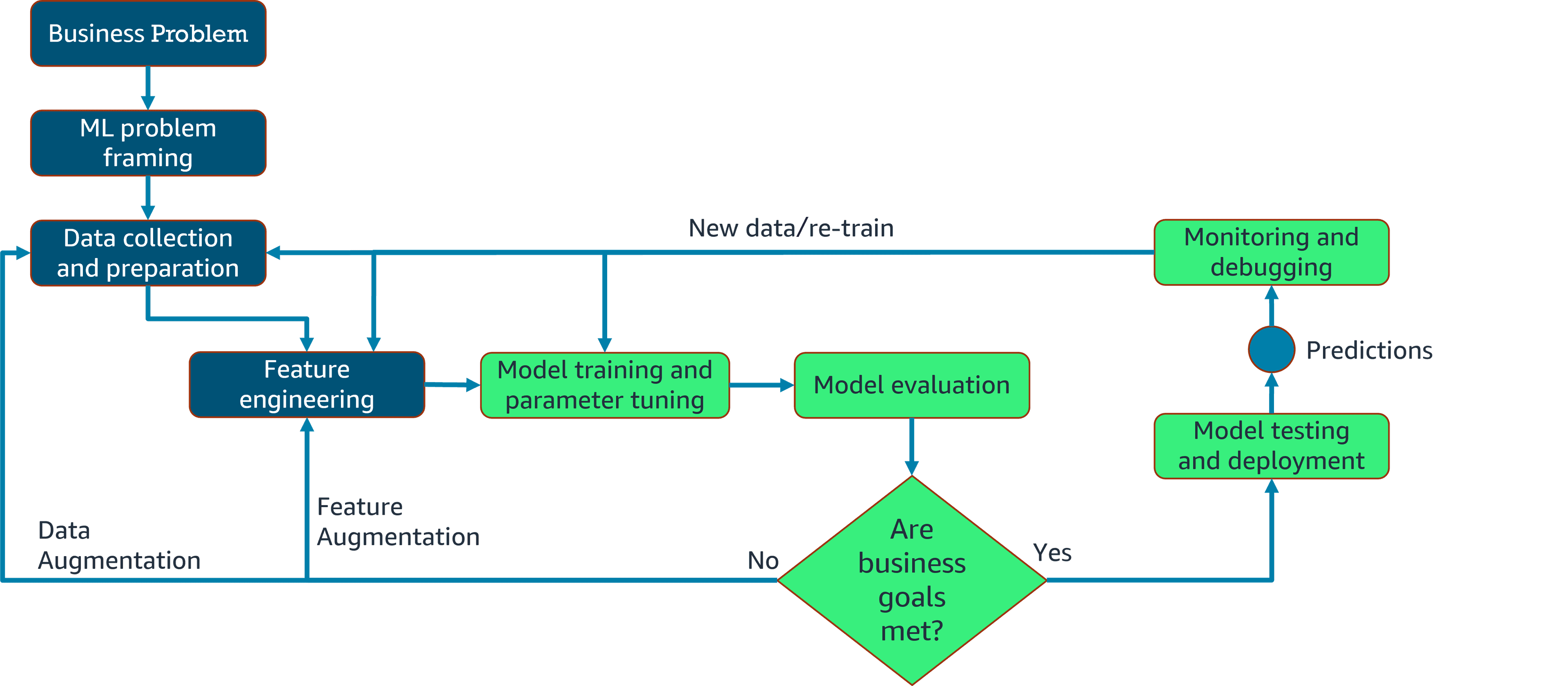
The Machine learning lifecycle refers to the end-to-end process of developing, deploying, and maintaining machine learning models from identifying the business problem to the deploying and monitoring the model.
Machine learning AWS services
SageMaker AI is the fully managed ML service from AWS that you can use to perform all the steps of an ML workflow, from data collection to model deployment.
In a single unified visual interface, you can perform the following tasks:
- Collect and prepare data with a low-code tool such as SageMaker Data Wrangler or your custom scripts, notebooks, or data processing containers.
- Build and train machine learning models with a low-code solution such as SageMaker Canvas. You can also use pre-trained algorithms, built-in algorithms, or supported ML frameworks such as scikit-learn, MXNet, or PyTorch. Finally, you can also bring your own custom packages and code by bringing custom Docker images while benefiting from the managed infrastructure of SageMaker AI.
- Deploy the models and monitor the performance of their predictions.
Machine learning models
SageMaker AI supports pre-trained models, built-in algorithms, and custom Docker images. It provides several built-in general-purpose algorithms that can be used for the following:
- Supervised learning with either classification or regression problems
- Unsupervised learning for tasks such as clustering, dimension reduction, pattern recognition, and anomaly detection
- Image processing for image classification, object detection, and computer vision as well as time series
- The analysis of textual documents used in natural language processing, document classification or summarization, topic modeling or classification, and language transcription or translation
Machine learning model performance evaluation
Evaluation occurs after a model has been trained. The data you use is partitioned into three parts: training set, validation set, and test set.
A model can be underfit, overfit, or balanced. Underfit is when the model performs poorly on the training data. Overfit when the model performs well on the training data but does not perform well on the evaluation data. Overfitting and underfitting are linked to the bias (the gap between your predicted value and the actual value) and the variance (how dispersed your predicted values are) of the models.
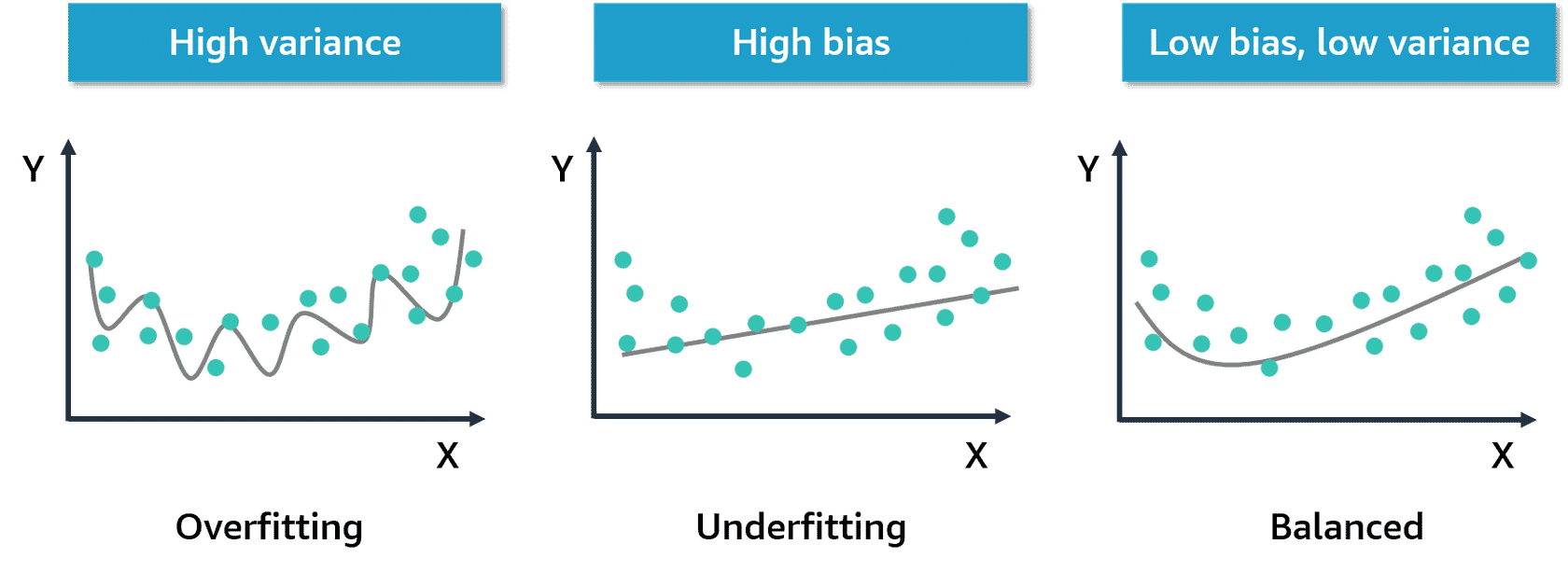
Balanced models have low bias and low variance
Model deployment
Model deployment is the integration of the model and its resources into a production environment so that it can be used to create predictions. Deployment options are self-hosted, when you deploy the model on your own infrastructure, or managed, when you deploy your models on a managed cloud platform.
You can use SageMaker AI to deploy a model to get predictions in several ways: real time, batch, serverless, or asynchronous.
MLOps
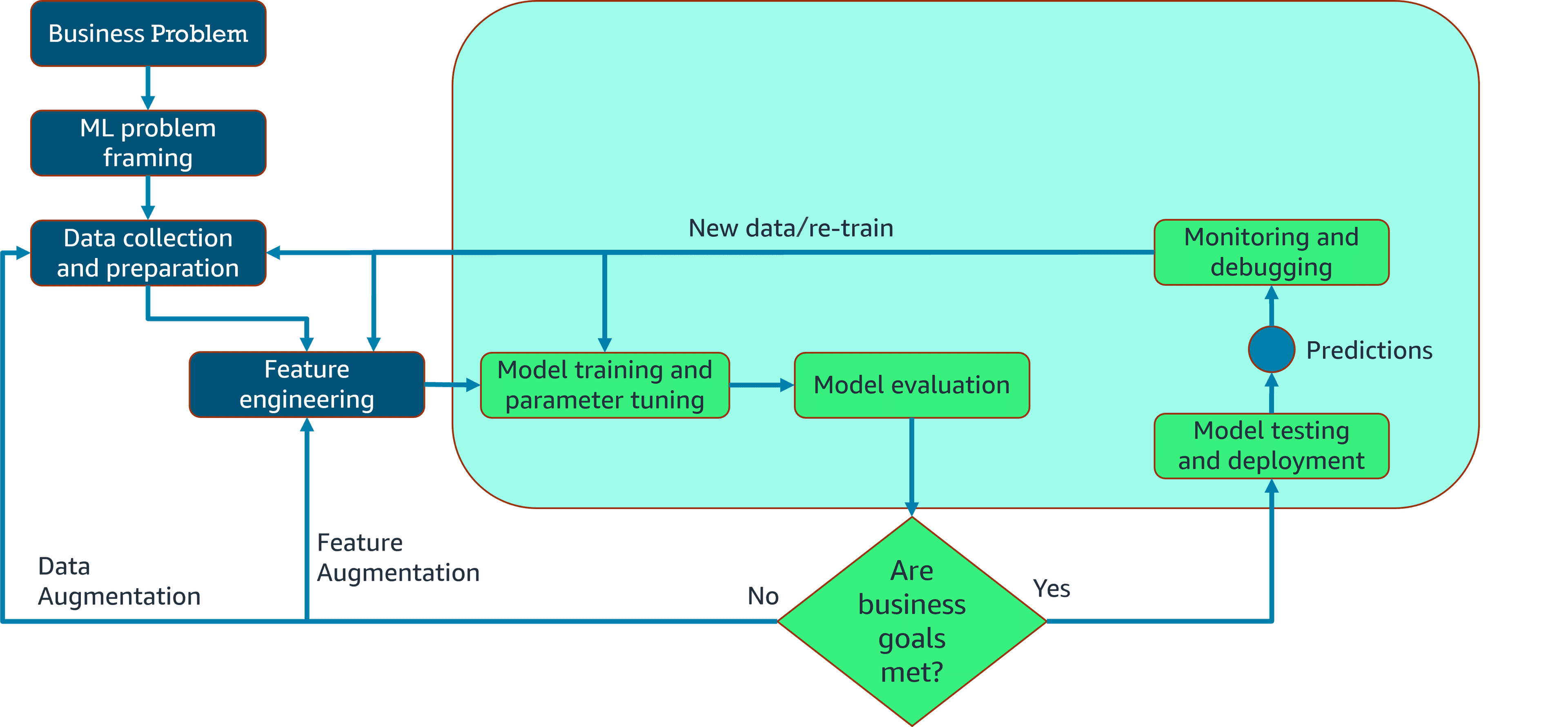
Machine learning operations, or MLOps, refers to the practice of operationalizing and streamlining the end-to-end machine learning lifecycle, from model development and deployment to monitoring and maintenance. It helps ensure that models are not just developed but also deployed, monitored, and retrained systematically and repeatedly.
It is an extension of the DevOps principles and practices to the specific domain of machine learning systems.