Responsible AI
As you develop your AI system, whether it is a traditional or generative AI application, it is important to incorporate responsible AI.
What is responsible AI?

Responsible AI refers to practices and principles that ensure that AI systems are transparent and trustworthy while mitigating potential risks and negative outcomes. These responsible standards should be considered throughout the entire lifecycle of an AI application. This includes the initial design, development, deployment, monitoring, and evaluation phases.
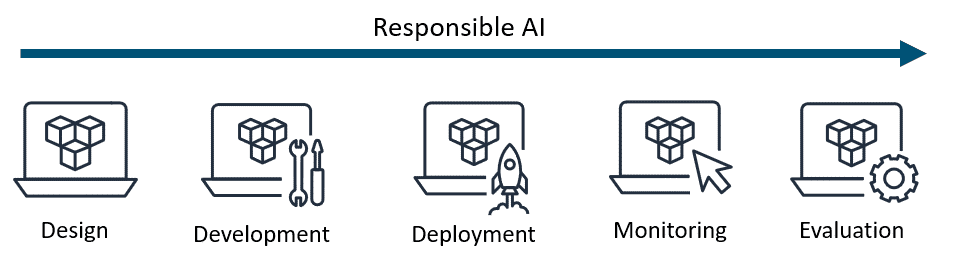
To operate AI responsibly, companies should proactively ensure the following about their system:
- It is fully transparent and accountable, with monitoring and oversight mechanisms in place.
- It is managed by a leadership team accountable for responsible AI strategies.
- It is developed by teams with expertise in responsible AI principles and practices.
- It is built following responsible AI guidelines.
What type of AI requires responsible AI?
Responsible AI is not exclusive to any one form of AI. It should be considered when you are building traditional or generative AI systems.
Traditional machine learning models perform tasks based on the data you provide. They can make predictions such as ranking, sentiment analysis, image classification, and more. However, each model can perform only one task. And to successfully do it, the model needs to be carefully trained on the data. As they train, they analyze the data and look for patterns. Then these models make a prediction based on these patterns.
Some examples of traditional AI include recommendation engines, gaming, and voice assistance.
Generative AI offers business value
The potential of FMs is incredibly exciting. There are several FMs available, each with unique strengths and characteristics.
New architectures are expected to arise in the future, and this diversity of FMs will set off a wave of innovation. This stands to spark the following business values that companies can benefit from:
- Creativity: Create new content and ideas, including conversations, stories, images, videos, and music.
- Productivity: Radically improve productivity across all lines of business, use cases, and industries.
- Connectivity: Connect and engage with customers and across organizations in new ways.
In the next lesson, you will learn about the challenges that responsible AI addresses.