Core Dimensions of Responsible AI
Core dimensions of responsible AI
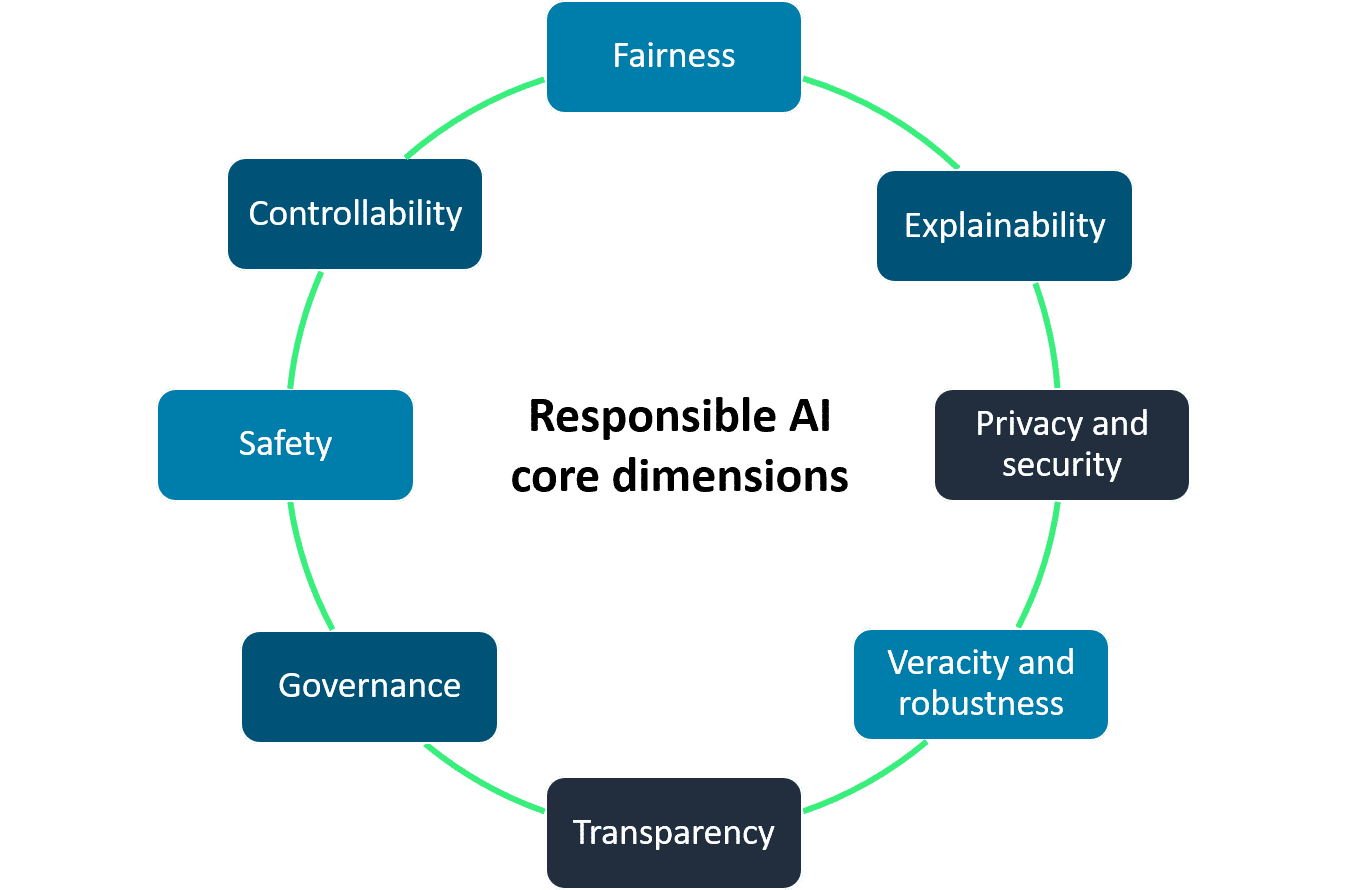
The core dimensions of responsible AI include fairness, explainability, privacy and security, robustness, governance, transparency, safety, and controllability. No one dimension is a standalone goal for responsible AI. In fact, each topic should be considered as a required part for a complete implementation of responsible AI.
You will find that there is considerable overlap between many of these topics. For example, you will find that when you implement transparency in your AI system, elements of explainability, fairness, and governance will be required. Next, you will explore how each of these topics is used in responsible AI.

Fairness
Fairness is crucial for developing responsible AI systems. With fairness, AI systems promote inclusion, prevent discrimination, uphold responsible values and legal norms, and build trust with society.
You should consider fairness in your AI applications to create systems suitable and beneficial for all.

Explainability
Explainability refers to the ability of an AI model to clearly explain or provide justification for its internal mechanisms and decisions so that it is understandable to humans.
Humans must understand how models are making decisions and address any issues of bias, trust, or fairness.

Privacy and security
Privacy and security in responsible AI refers to data that is protected from theft and exposure. More specifically, this means that at a privacy level, individuals control when and if their data can be used. At the security level, it verifies that no unauthorized systems or unauthorized users will have access to the individual’s data.
When this is properly implemented and deployed in an AI system, users can trust that their data is not going to be compromised and used without their authorization.

Transparency
Transparency communicates information about an AI system so stakeholders can make informed choices about their use of the system. Some of this information includes development processes, system capabilities, and limitations.
It provides individuals, organizations, and stakeholders access to assess the fairness, robustness, and explainability of AI systems. They can identify and mitigate potential biases, reinforce responsible standards, and foster trust in the technology.

Veracity and robustness
Veracity and robustness in AI refers to the mechanisms to ensure an AI system operates reliably, even with unexpected situations, uncertainty, and errors.
The goal of veracity and robustness in responsible AI is to develop AI models that are resilient to changes in input parameters, data distributions, and external circumstances.
This means that the AI model should retain reliability, accuracy, and safety in uncertain environments.

Governance
Governance is a set of processes that are used to define, implement, and enforce responsible AI practices within an organization.
Governance addresses various responsible, legal, or societal problems that generative AI might invite.
For example, governance policies can help to protect the rights of individuals to intellectual property. It can also be used to enforce compliance with laws and regulations. Governance is a vital component of responsible AI for an organization that seeks to incorporate responsible best practices.

Safety
Safety in responsible AI refers to the development of algorithms, models, and systems in such a way that they are responsible, safe, and beneficial for individuals and society as a whole.
This means that AI systems should be carefully designed and tested to avoid causing unintended harm to humans or the environment. Things like bias, misuse, and uncontrolled impacts need to be proactively considered.

Controllability
Controllability in responsible AI refers to the ability to monitor and guide an AI system's behavior to align with human values and intent. It involves developing architectures that are controllable, so that any unintended issues can be managed and addressed.
By ensuring controllability, responsible AI can help mitigate risks, promote fairness and transparency, and ensure that AI systems benefit society as a whole.
Business benefits of responsible AI
Responsible AI offers key business benefits in the development and deployment of AI systems.
Increased trust and reputation
Customers are more likely to interact with AI applications, if they believe the system is fair and safe. This enhances their reputation and brand value.
Regulatory compliance
As AI regulations emerge, companies with robust ethical AI frameworks are better positioned to comply with guidelines on data privacy, fairness, accountability, and transparency.
Mitigating risks
Responsible AI practices help mitigate risks such as bias, privacy violations, security breaches, and unintended negative impacts on society. This reduces legal liabilities and financial costs.
Competitive advantage
Companies that prioritize responsible AI can differentiate themselves from competitors and gain a competitive edge, especially as consumer awareness of AI ethics grows.
Improved decision-making
AI systems built with fairness, accountability, and transparency in mind are more reliable and less likely to produce biased or flawed outputs, which leads to better data-driven decisions.
Improved products and business
Responsible AI encourages a diverse and inclusive approach to AI development. Because it draws on varied perspectives and experiences, it can drive more creative and innovative solutions.
Next, you will test what you have learned in this section with a knowledge check.