Responsible AI Challenges in Traditional AI and Generative AI
Accuracy of models
The number one problem that developers face in AI applications is accuracy. Both traditional and generative AI applications are powered by models that are trained on datasets. These models can make predictions or generate content based only on the data they are trained on. If they are not trained properly, you will get inaccurate results. Therefore, it is important to address bias and variance in your model.
Bias is one of the biggest challenges a developer faces in AI systems. Bias in a model means that the model is missing important features of the datasets. This means that the data is too basic. Bias is measured by the difference between the expected predictions of the model and the true values we are trying to predict. If the difference is narrow, then the model has low bias. If the difference is wide, then the model has a high bias.
When a model has a high bias, it is underfitted. Underfitted means that the model is not capturing enough difference in the features of the data, and therefore, the model performs poorly on the training data.
Bias-variance trade-off
Bias-variance tradeoff is when you optimize your model with the right balance between bias and variance. This means that you need to optimize your model so that it is not underfitted or overfitted. The goal is to achieve a trained model with the lowest bias and lowest variance tradeoff for a given data set.
Review these examples of model that are underfitted, overfitted, and balanced.
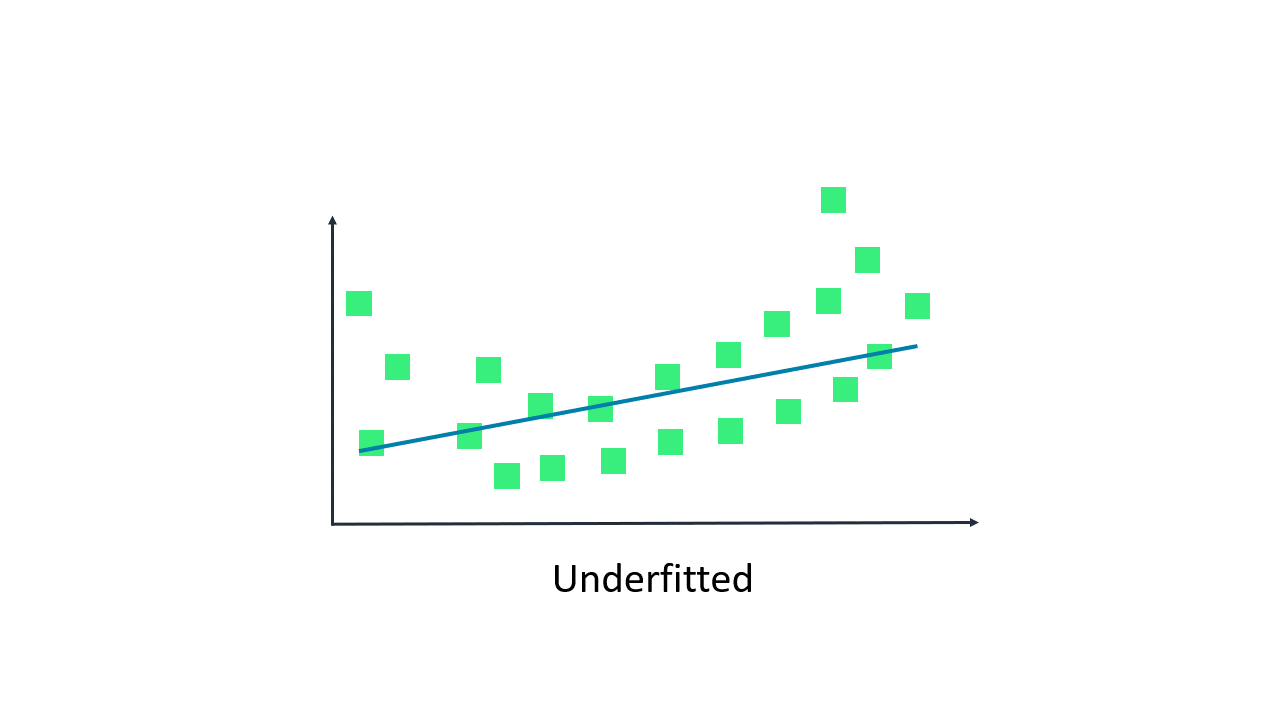
In the underfitted example, the bias is high and the variance is low. Here the regression is a straight line. This shows us that the model is underfitting the data because it is not capturing all the features of the data.
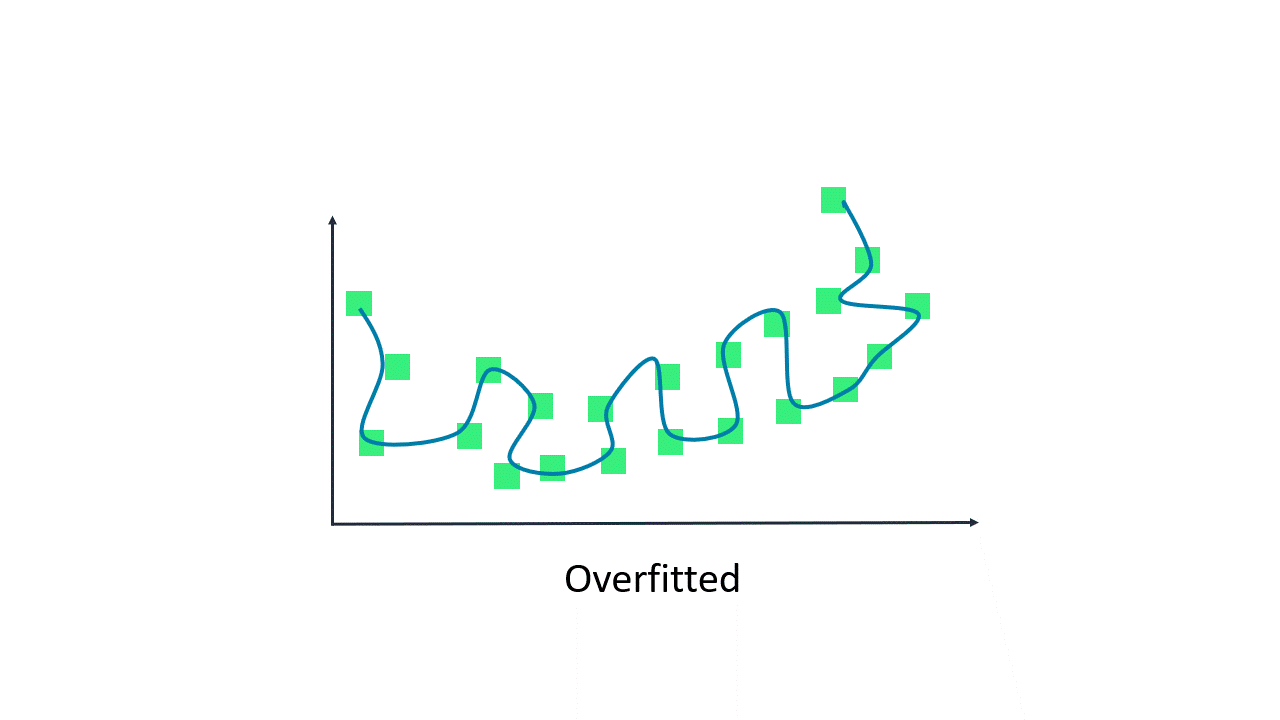
In the overfitted example, bias is low and the variance is high. Here the regression curve perfectly fits the data. This means that it is capturing noise and is essentially memorizing the data. It won't perform well on new data.
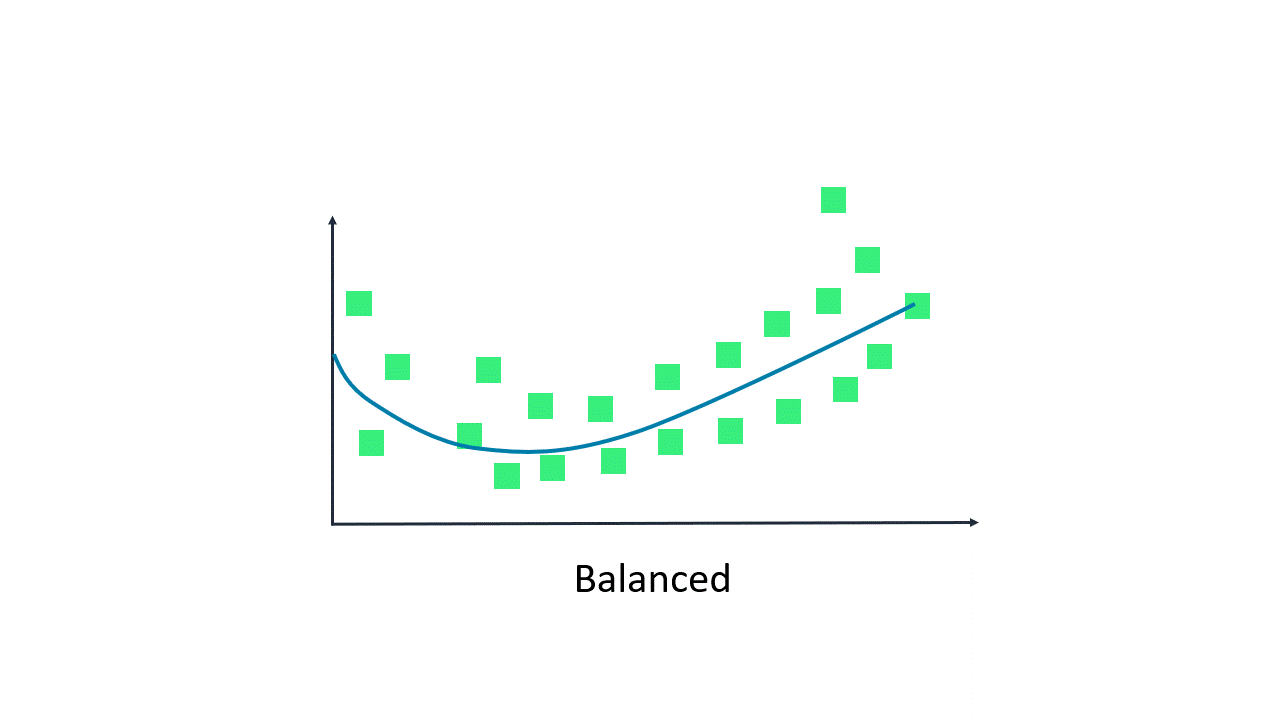
In the balanced example, the bias is low and the variance is low. Here the regression is a curve. This is what you want. Its capturing enough features of the data, without capturing noise.
To help overcome bias and variance errors, you can use the following:
Cross validation
Cross-validation is a technique for evaluating ML models by training several ML models on subsets of the available input data and evaluating them on the complementary subset of the data. Cross-validation should be used to detect overfitting.
Increase data
Add more data samples to increase the learning scope of the model.
Regularization
Use regularization. Regularization is a method that penalizes extreme weight values to help prevent linear models from overfitting training data examples.
Simpler models
Use simpler model architectures to help with overfitting. If the model is underfitting, the model might be too simple.
Dimension reduction (Principal component analysis)
Apply dimension reduction. Dimension reduction is an unsupervised machine learning algorithm that attempts to reduce the dimensionality (number of features) within a dataset while still retaining as much information as possible.
Stop training early
End training early so that the model does not memorize the data.
Challenges of generative AI

Just as generative AI has its unique set of benefits, it also has a unique set of challenges. Some of these challenges include toxicity, hallucinations, intellectual property, and plagiarism, and cheating.
Review each topic to learn more.
Toxicity
Toxicity is the possibility of generating content (whether it be text, images, or other modalities) that is offensive, disturbing, or otherwise inappropriate. This is a primary concern with generative AI. It is hard to even define and scope toxicity. The subjectivity involved in determining what constitutes toxic content is an additional challenge, and the boundary between restricting toxic content and censorship can be murky and dependent on context and culture.
For example, should quotations that would be considered offensive out of context be suppressed if they are clearly labeled as quotations? What about opinions that might be offensive to some users but are clearly labeled as opinions?
Technical challenges include offensive content that might be worded in a very subtle or indirect fashion, without the use of obviously inflammatory language.
Hallucinations
Hallucinations are assertions or claims that sound plausible but are verifiably incorrect. Considering the next-word distribution sampling employed by large language models (LLMs), it is perhaps not surprising that in more objective or factual use cases, LLMs are susceptible to hallucinations.
For example, a common phenomenon with current LLMs is creating nonexistent scientific citations. Suppose that an LLMs is prompted with the request, “Tell me about some papers by" a particular author. The model is not actually searching for legitimate citations but generating ones from the distribution of words associated with that author. The result might include realistic titles and topics in the area of the author. However, these might not be real articles, and they might include plausible coauthors but not actual ones.
Intellectual property
Protecting intellectual property was a problem with early LLMs. This was because the LLMs had a tendency to occasionally produce text or code passages that were verbatim of parts of their training data, resulting in privacy and other concerns. But even improvements in this regard have not prevented reproductions of training content that are more ambiguous and nuanced.
Consider this prompt for a generative image model, “Create a painting of a skateboarding cat in the style of Andy Warhol.” If the model is able to do so in a convincing yet still original manner because it was trained on actual Warhol images, objections to such mimicry might arise.
Plagiarism and cheating
The creative capabilities of generative AI give rise to worries that it will be used to write college essays, writing samples for job applications, and other forms of cheating or illicit copying. Debates on this topic are happening at universities and many other institutions, and attitudes vary widely.
Some are in favor of explicitly forbidding any use of generative AI in settings where content is being graded or evaluated, while others argue that educational practices must adapt to, and even embrace, the new technology. But the underlying challenge of verifying that a given piece of content was authored by a person is likely to present concerns in many contexts.
Disruption of the nature of work
The proficiency with which generative AI is able to create compelling text and images, perform well on standardized tests, write entire articles on given topics, and successfully summarize or improve the grammar of provided articles has created some anxiety. There is a concern that some professions might be replaced or seriously disrupted by the technology.
Although this might be premature, it does seem that generative AI will have a transformative effect on many aspects of work. It is possible that many tasks previously beyond automation could be delegated to machines.
In the next lesson, you will learn about the core dimensions of responsible AI.