Business case
Introduction: AnyCompany, a telecom company
AnyCompany is a telecommunications provider offering phone and internet services.
Typically, customers experiencing issues contact AnyCompany's support center by phone, a process that is both costly and inefficient.
To streamline support, AnyCompany is shifting toward online solutions, initially creating an FAQ section on their website to address common problems. Despite this, the volume of online support tickets remains high. To further reduce the workload on their staff and enhance customer service efficiency, AnyCompany is exploring the potential of generative artificial intelligence (AI) to develop a chatbot. The chatbot would be capable of guiding customers, answering common issues, and performing certain tasks autonomously such as ordering a new phone, upgrading the phone plan to get more 5G data, and so on.
AnyCompany has a target of decreasing the number of online tickets by 70 percent after putting the chatbot into production. The company will also monitor the customer satisfaction score by providing a survey to their customers after solving their issues. With the addition of the chatbot, the company wishes to reach a satisfaction score of at least 4 out of 5.
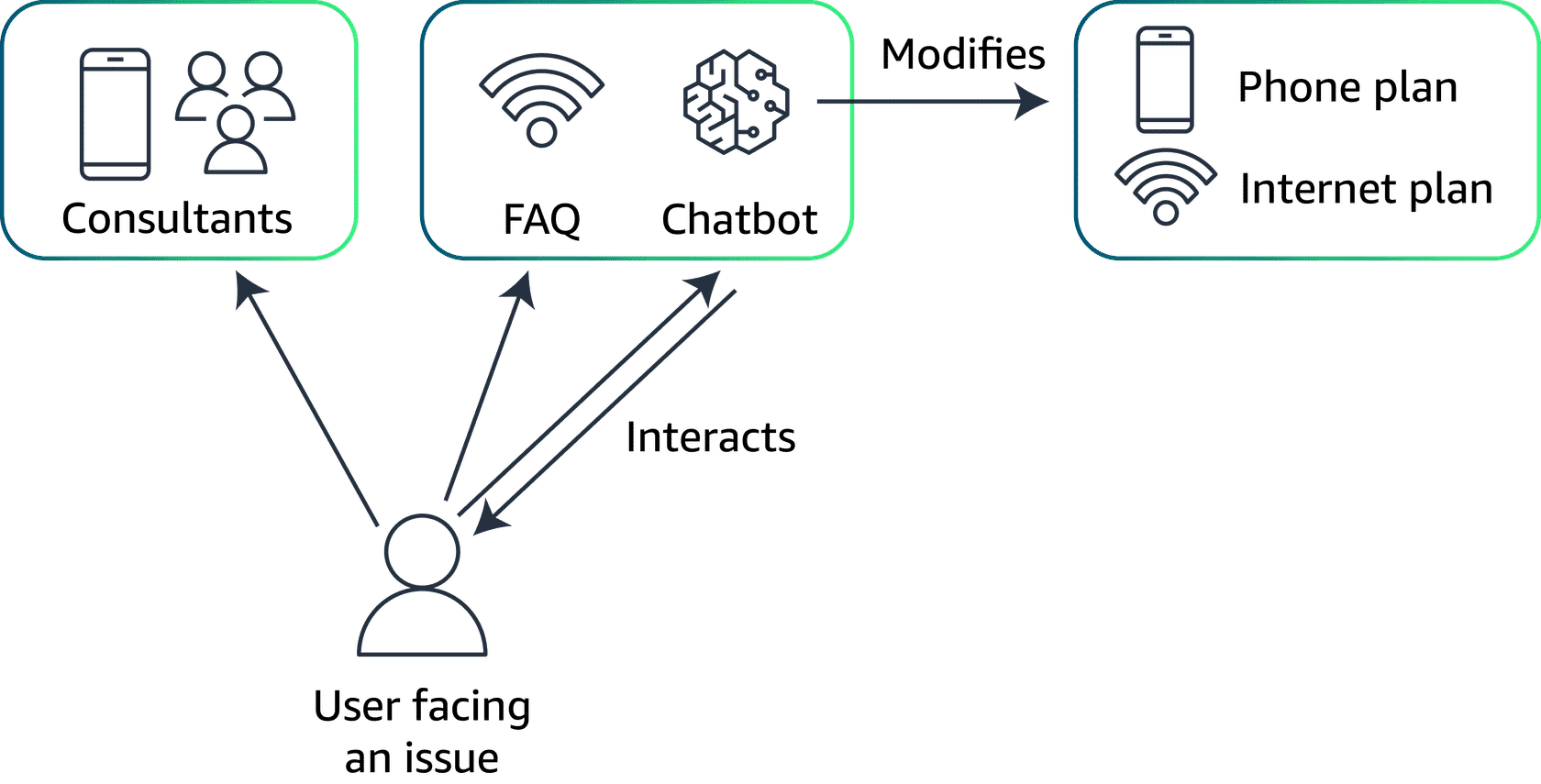
Architecture diagram of the AnyCompany support system.
Look further into the solution
To build the chatbot, AnyCompany needs to choose a foundation model (FM). The model will need capabilities in natural language processing (NLP) and understanding, in addition to an integration with AnyCompany's backend system for automation.
AnyCompany needs to choose a large language model (LLM) because these FMs have the ability to understand and process natural language. LLMs are trained over a large amount of public data, which is great for general language understanding. However, this is not optimal to answer specific customer requests about AnyCompany's services. Therefore, AnyCompany needs a way to incorporate data and a knowledge base coming from AnyCompany to improve the accuracy of the chatbot's answers by providing it with more context.
This additional data might come from chat logs, previously handled support tickets, or even support call recordings. The data needs to be collected, anonymized, and cleansed to be incorporated in a knowledge base that can, in turn, be used by the chatbot.
Finally, because AnyCompany is willing to have the chatbot handle some tasks autonomously, the chatbot needs to be able to launch additional functions that can modify parameters in customers' accounts.
In the next lesson, you will learn about how RAG can help AnyCompany.