Fine-Tuning
Introduction
Although foundation models are highly versatile, they often require fine-tuning to tailor their broad capabilities to specific applications or to enhance their performance in particular domains. Fine-tuning is critical because it helps to do the following:
- Increase specificity: Adapt the model’s responses or predictions to the nuances of a specific domain or task that were not adequately covered in the initial training.
- Improve accuracy: Enhance the model's performance on specialized tasks by training on domain-specific data, thereby reducing errors that occur due to the generic nature of foundational training.
- Reduce biases: Address and mitigate any biases inherent in the initial training data, making the model more fair and appropriate for different applications.
- Boost efficiency: Streamline the model’s operations within specific contexts, potentially reducing computational requirements and speeding up response times.
In the next section, you will look further into the different ways to fine-tune a foundation model.
The different fine-tuning approaches
- Instruction tuning: This approach involves retraining the model on a new dataset that consists of prompts followed by the desired outputs. This is structured in a way that the model learns to follow specific instructions better. This method is particularly useful for improving the model's ability to understand and execute user commands accurately, making it highly effective for interactive applications like virtual assistants and chatbots.
- Reinforcement learning from human feedback (RLHF): This approach is a fine-tuning technique where the model is initially trained using supervised learning to predict human-like responses. Then, it is further refined through a reinforcement learning process, where a reward model built from human feedback guides the model toward generating more preferable outputs. This method is effective in aligning the model’s outputs with human values and preferences, thereby increasing its practical utility in sensitive applications.
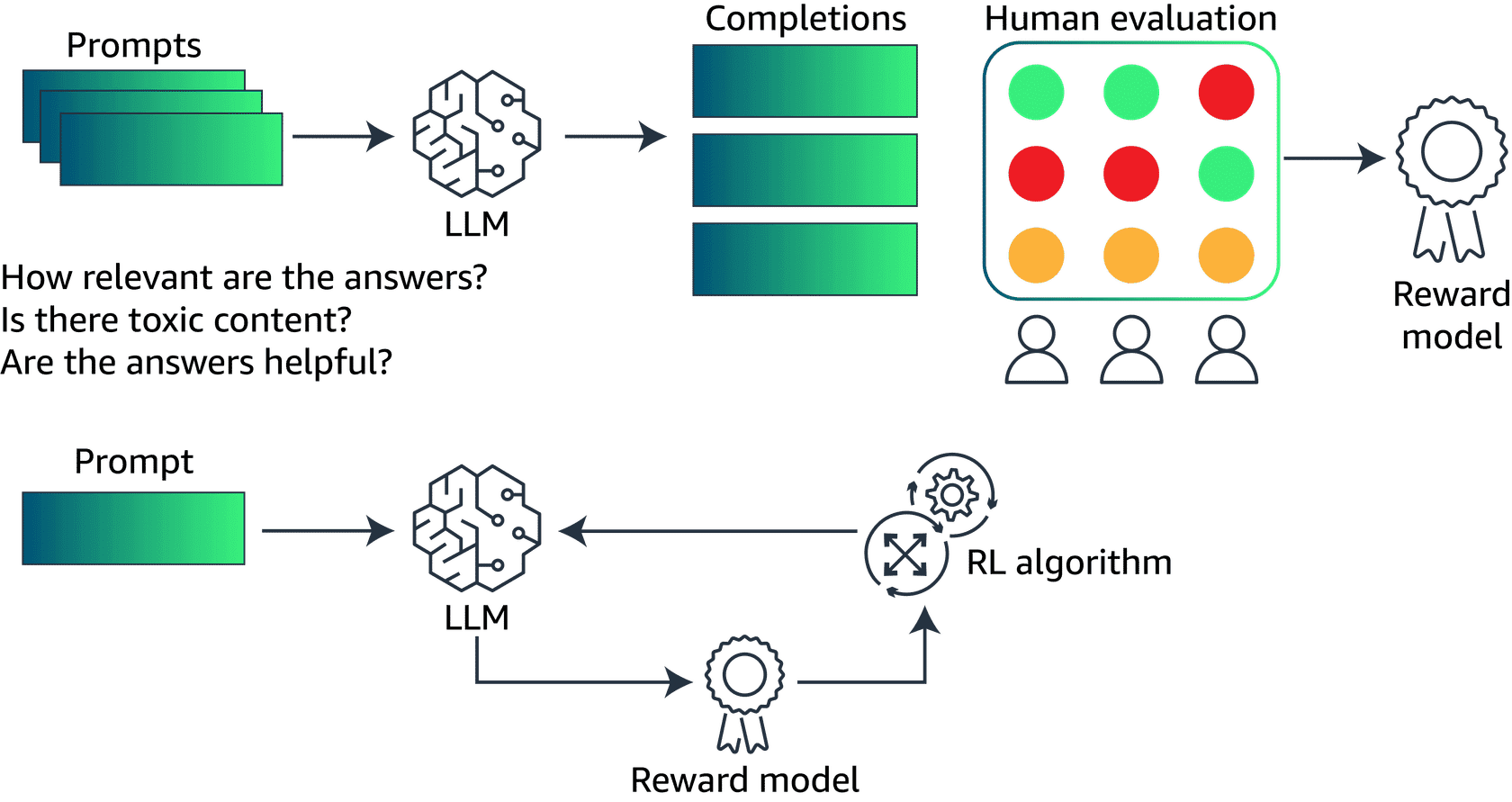
RLHF refers to the improvement of the model by learning from feedback, such as ratings, preferences, demonstrations, helpfulness, or toxicity, provided by humans. RLHF is used during the pretraining phase of the model but can also be used to fine-tune the model.
- Adapting models for specific domains: This approach involves fine-tuning the model on a corpus of text or data that is specific to a particular industry or sector. An example of this would be legal documents for a legal AI or medical records for a healthcare AI. This specificity enables the model to perform with a higher degree of relevance and accuracy in domain-specific tasks, providing more useful and context-aware responses.
- Transfer learning: This approach is a method where a model developed for one task is reused as the starting point for a model on a second task. For foundational models, this often means taking a model that has been trained on a vast, general dataset, then fine-tuning it on a smaller, specific dataset. This method is highly efficient in using learned features and knowledge from the general training phase and applying them to a narrower scope with less additional training required.
- Continuous pretraining: This approach involves extending the training phase of a pre-trained model by continuously feeding it new and emerging data. This approach is used to keep the model updated with the latest information, vocabulary, trends, or research findings, ensuring its outputs remain relevant and accurate over time.
Preparing the data for the fine-tuning step
During the initial training phase, a foundational model is trained on a vast and diverse dataset. This dataset typically encompasses a wide range of topics to develop a broad understanding and general capabilities. The goals during this phase are as follows:
- Extensive coverage: Ensuring the dataset covers a broad spectrum of knowledge to give the model a robust foundational understanding
- Diversity: Including varied types of data from numerous sources to equip the model with the ability to handle a wide array of tasks
- Generalization: Focusing on building a model that can generalize across different tasks and domains without specific tailoring
Data preparation for this phase involves collecting as much data as possible. The data is often from publicly available sources, curated datasets, and sometimes proprietary data, depending on the model's intended usage. The data needs thorough cleaning and possibly anonymization to ensure privacy and compliance with regulations.
Data preparation for fine-tuningFine-tuning, on the other hand, is a more targeted process where a pretrained model is adapted to perform well on a specific task or within a particular domain. The data preparation for fine-tuning is distinct from initial training due to the following reasons:
- Specificity: The dataset for fine-tuning is much more focused, containing examples that are directly relevant to the specific tasks or problems the model needs to solve.
- High relevance: Data must be highly relevant to the desired outputs. Examples include legal documents for a legal AI or customer service interactions for a customer support AI.
- Quality over quantity: Although the initial training requires massive amounts of data, fine-tuning can often achieve significant improvements with much smaller, but well-curated datasets.
Key steps in fine-tuning data preparation
The following list walks through the key steps in fine-tuning data preparation:
- Data curation: Although it is a continuation, this involves a more rigorous selection process to ensure every piece of data is highly relevant. This step also ensures the data contributes to the model's learning in the specific context.
- Labeling: In fine-tuning, the accuracy and relevance of labels are paramount. They guide the model's adjustments to specialize in the target domain.
- Governance and compliance: Considering fine-tuning often uses more specialized data, ensuring data governance and compliance with industry-specific regulations is critical.
- Representativeness and bias checking: It is essential to ensure that the fine-tuning dataset does not introduce or perpetuate biases that could skew the model's performance in undesirable ways.
- Feedback integration: For methods like RLHF, incorporating user or expert feedback directly into the training process is crucial. This is more nuanced and interactive than the initial training phase.
You have learned about the different ways to fine-tune a foundation model. In the next lesson, you will learn about model evaluation.