Evaluate results
Introduction
Evaluating the performance of generative AI models is critical for understanding their effectiveness and ensuring they meet intended objectives. Two of the most common evaluation methods are human evaluation and the use of benchmark datasets. Each method provides unique insights and is suitable for different aspects of model performance assessment.
Human evaluation
Human evaluation involves real users interacting with the AI model to provide feedback based on their experience. This method is particularly valuable for assessing qualitative aspects of the model, such as the following:
- User experience: How intuitive and satisfying is the interaction with the model from the user's perspective?
- Contextual appropriateness: Does the model respond in a way that is contextually relevant and sensitive to the nuances of human communication?
- Creativity and flexibility: How well does the model handle unexpected queries or complex scenarios that require a nuanced understanding?
Human evaluation is often used for iterative improvements and tuning the model to better meet user expectations.
Benchmark datasets
Benchmark datasets, on the other hand, provide a quantitative way to evaluate generative AI models. These datasets consist of predefined datasets and associated metrics that offer a consistent, objective means to measure model performances. This might include the following:
- Accuracy: How accurately does the model perform specific tasks according to predefined standards?
- Speed and efficiency: How quickly does the mode generate responses and how does this impact operational efficiency?
- Scalability: Can the mode maintain its performance as the scale of data or number of users increases?
Benchmark datasets are particularly useful for initial testing phases to ensure that the model meets certain technical specifications before it is put through more subjective human evaluations. They are also essential for comparing performance across different models or different iterations of the same model.
Create relevant questions
First, subject matter experts (SMEs) create relevant and challenging questions related to the topic of interest or specific documents.

- 1
- 2
- 3
- 4
- 5
The evaluation of LLM performance using a benchmark dataset can be automated using an LLM as a judge approach.
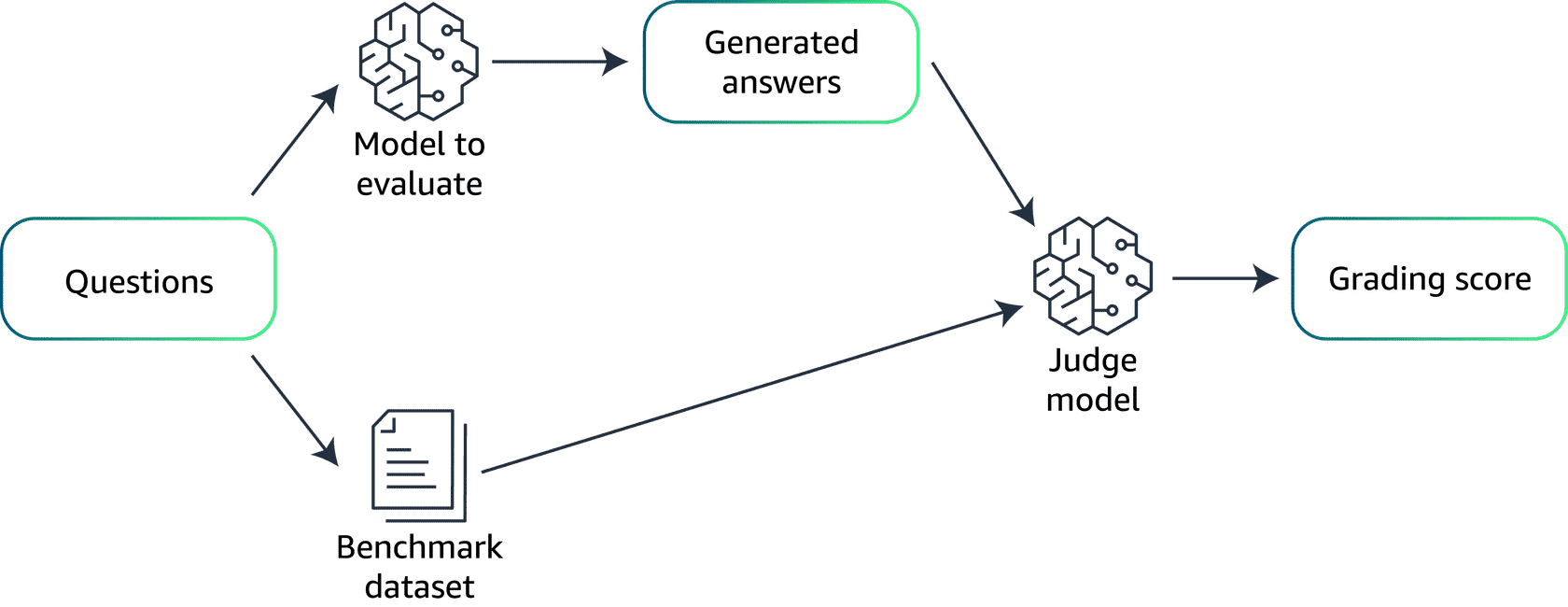
2: Benchmark dataset
2: Benchmark dataset
The benchmark dataset contains both the answers and context provided by the SMEs.
Combined approach
In practice, a combination of both human evaluation and benchmark datasets is often used to provide a comprehensive overview of a model's performance. Although benchmark datasets can quantify the model's technical capabilities, human evaluation brings an essential human-centric perspective that benchmarks cannot capture alone. This combined approach ensures that the model is not only technically proficient but also effective and engaging in real-world scenarios.
AnyCompany business case
Review AnyCompany's business case. Before deploying the chatbot model into production, the company can evaluate the model's performances against benchmark datasets. After the model is in production, a real human will interact with the model and can rate their interaction. This helps the model to improve its accuracy as a function of time.
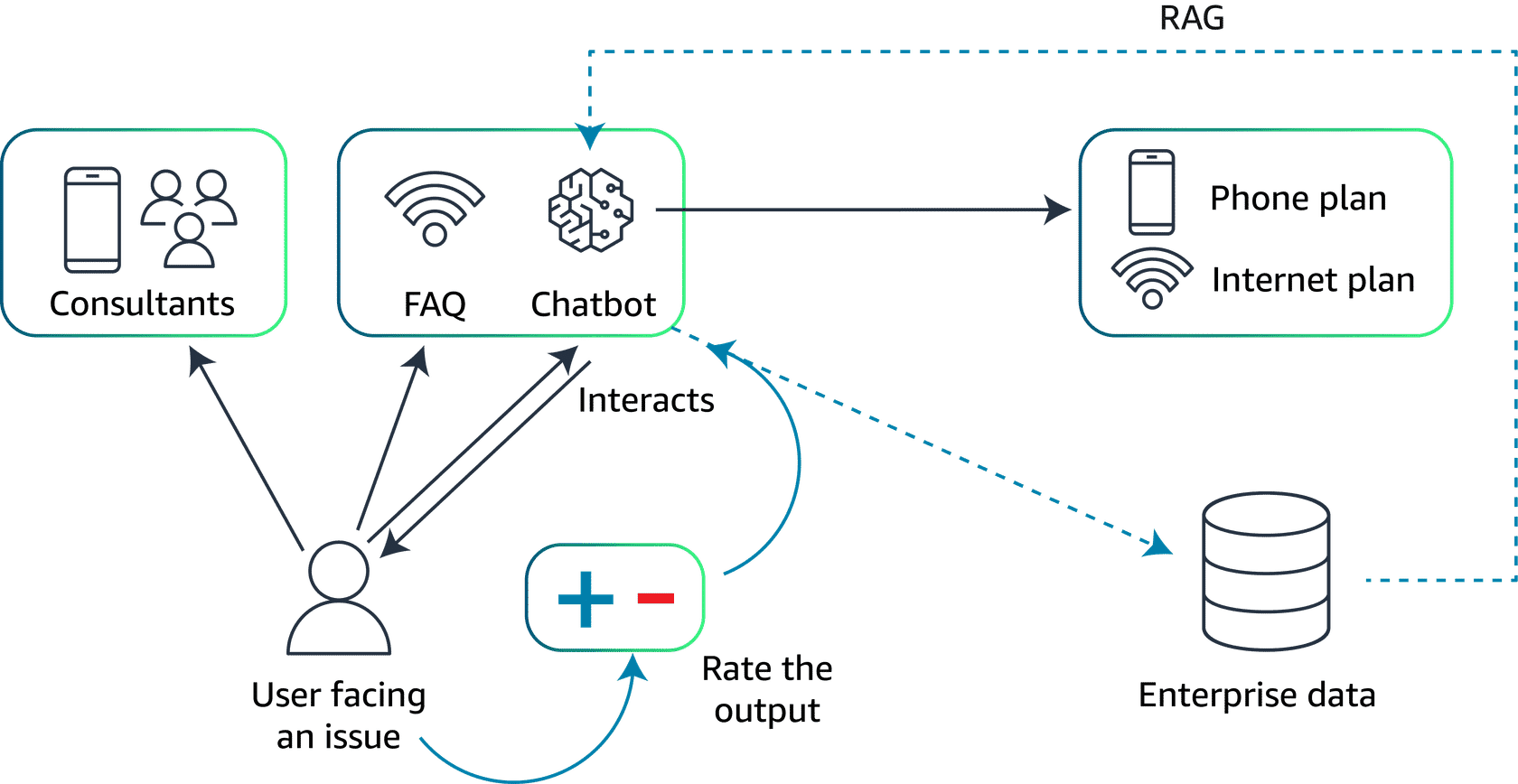
AnyCompany architecture diagram with a human rating the interaction with the model.
You have completed this lesson on evaluating results. Move on to the next lesson to test your knowledge.