Agents
Introduction
In this lesson, using the AnyCompany business case as an example, we illustrate the use of agents to meet business requirements.
Key functions of agents
Agents can serve different roles in a generative AI application, such as the following:
- Intermediary operations: Agents can act as intermediaries, facilitating communication between the generative AI model and various backend systems. The generative AI model handles language understanding and response generation. The various backend systems include items such as databases, CRM platforms, or service management tools.
- Actions launch: Agents can be used to run a wide variety of tasks. These tasks might include adjusting service settings, processing transactions, retrieving documents, and more. These actions are based on the users' specific needs understood by the generative AI model.
- Feedback integration: Agents can also contribute to the AI system's learning process by collecting data on the outcomes of their actions. This feedback helps refine the AI model, enhancing its accuracy and effectiveness in future interactions.
AnyCompany: The use of agents
AnyCompany is a telecom company using the power of generative AI to reduce the amount of tickets to be handled by their employees. To automatize the maximum number of tasks, AnyCompany need to combine agents with their generative AI model.
Following is a more detailed view of AnyCompany's architecture using agents. In this diagram, Agent 1 is used to take actions on customers' plans, based on their prompts. Agent 2 uses the conversation between the user and the chatbot to update or add more data to the enterprise data database. In turn, that refined data can be used in the RAG system to provide more appropriate answers later. Agent 3 is used to send a satisfaction survey to the user when the conversation ends. This will help AnyCompany monitor the satisfaction score and ensure that they meet their goal to improve this satisfaction score.
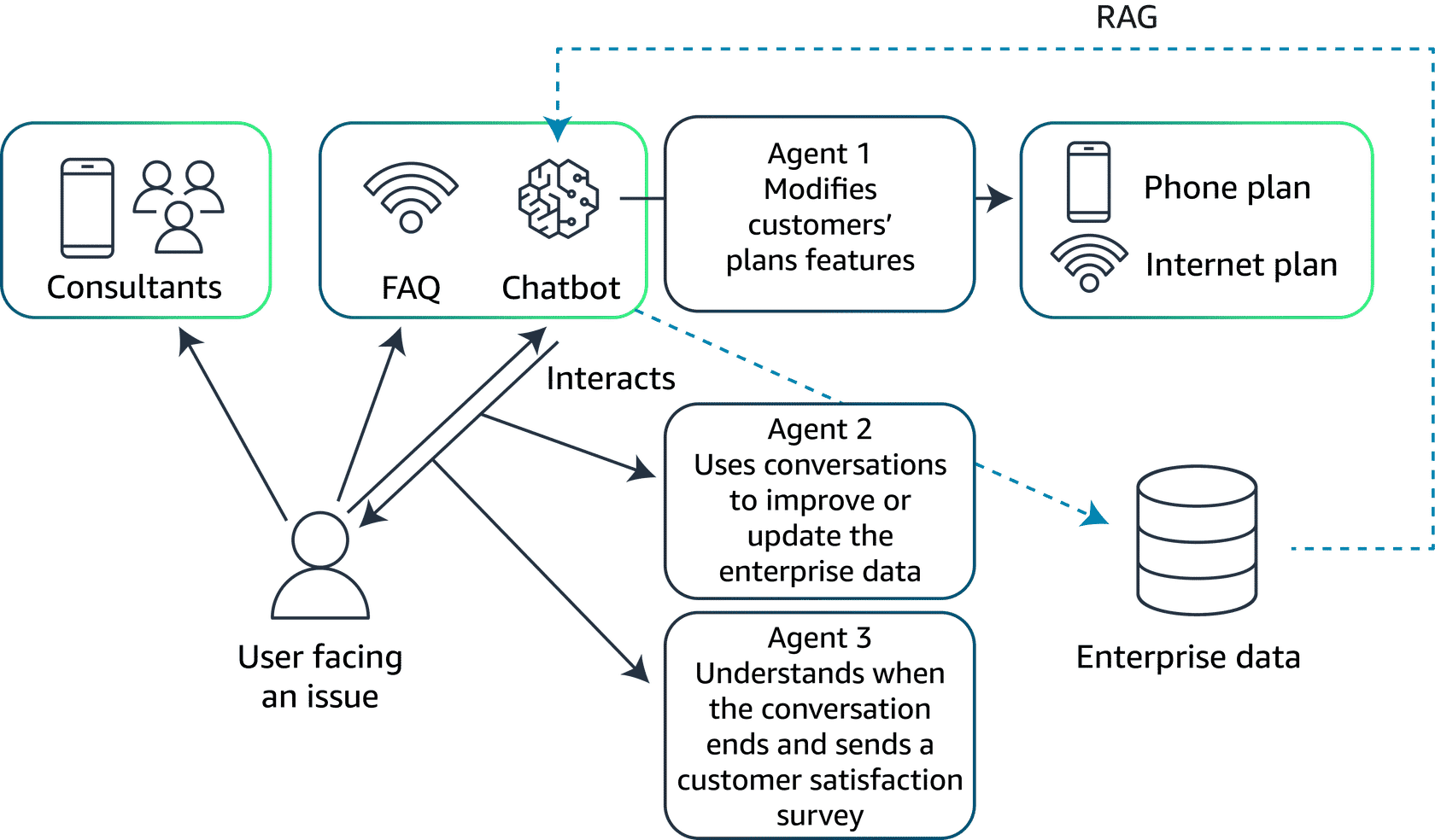
AnyCompany's architecture diagram including three agents.
Next, you will learn how to evaluate the results.